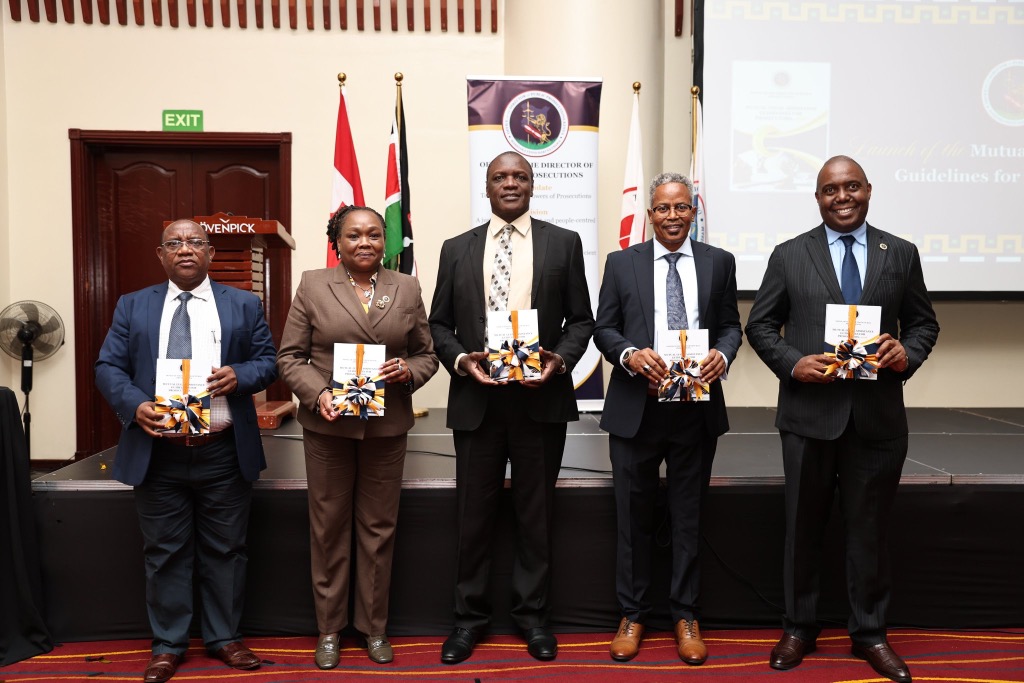
The Office of the of Public Prosecutions has unveiled new Mutual Legal Assistance (MLA) Guidelines aimed at enhancing the country’s capacity to investigate and prosecute transnational crimes through improved international cooperation.
The guidelines were officially launched by Secretary Prosecution Services Alloys Kemo, who spoke on behalf of Director of Public Prosecutions Renson Ingonga during the event.
In his address, Ingonga underscored the growing complexity of modern crime, noting that criminal networks are increasingly operating across borders and leveraging advancements in technology and global financial systems to evade detection.
“Mutual Legal Assistance is no longer optional, it is an essential legal bridge that enables countries to cooperate, exchange information, and gather evidence in a structured and lawful manner,” he said.
The newly introduced guidelines are anchored in Kenya’s Mutual Legal Assistance Act, which provides the legal framework for collaboration between Kenya and foreign jurisdictions in criminal investigations and prosecutions.
The ODPP, as the designated Competent Authority, is tasked with processing both incoming and outgoing MLA requests. Officials said the guidelines are intended to streamline procedures, improve efficiency, and ensure compliance with both domestic and international legal standards when handling cross-border cases.
They also seek to enhance coordination between Kenyan investigative agencies and their counterparts abroad.Kemo noted that the framework will play a critical role in addressing crimes such as money laundering, terrorism financing, cybercrime, and human trafficking, which often involve multiple jurisdictions.
“The nature of crime today demands that we work seamlessly with our international partners. These guidelines will ensure that our processes are clear, timely, and effective in supporting justice beyond our borders,” he said.
The ODPP emphasized that the guidelines also reinforce safeguards to protect the rights of individuals and uphold the rule of law, even as authorities pursue complex international cases.
Ingonga reiterated the office’s commitment to fostering strong partnerships with regional and global agencies, adding that effective implementation of the guidelines will be key to their success.
“As criminals continue to exploit jurisdictional boundaries, our response must be equally coordinated and robust,” he said.
The launch comes at a time when Kenya is seeking to strengthen its legal and institutional frameworks to combat increasingly sophisticated forms of transnational crime, positioning the country as a reliable partner in international justice cooperation.